Monday, December 6, 2010

Obama Revelations

#1: Changing Campaigning - How Obama's Campaigning Changed the Game


The Internet has changed the game. (Image thanks to abcnews.go.com)

Barack Obama may have been only one of a handful of presidential candidates with the opportunity to use the world of Web 2.0 to his or her campaigning advantage, but he saw and leaped on the opportunity, harnessing it to great effect. Even today he uses his YouTube channel to post videos to his online following. The videos can be fairly straightfoward, but a form of free advertising and expression nonetheless. Here's one of the most recent videos, from November 1st of this year:


Get out there and vote, from Obama. Reminiscent of FDR's fireside chats, these videos allow any number of people to tune in very easily, puts a face to the voice, and allows for Obama's campaign team to track the hits and general popularity of the internet techniques Obama used.

From Hoynes and Crouteau's Media & Society, "Candidates have complete control over their media images when they produce their campaign commercials. Television advertising is a central part of most electoral campaigns, and some evidence suggests that voters receive more information about candidates from campaign commercials than from news coverage." (Crouteau & Hoyes 237)

This observation is a tad out of date because, as Obama has proven, the Internet can be just as, if not more, effective than television in its appeal to an audience. From The New York Times came an article touching on this very subject. From Clare Cain Miller comes the article "How Obama's Internet Campaign Changed Politics".


The article smooths a lot of the furled areas of this revelation. "Mr. Trippi argued that those videos were more effective than television ads because viewers chose to watch them or received them from a friend instead of having their television shows interrupted." (Miller) On top of this, the article shows that the YouTube videos were watched for a rough total of 14.5 million hours, which would cost $47 million dollars to broadcast on television. There we already see Obama's clever utilization of modern technology.


'How many hits does my new vid have?!'
(Image thanks to i.telegraph.co.uk)

Because this is a new form of campaigning, we aren't as comfortable with what a candidate might look like through a screen, safe from criticism. Now that we're seeing what Obama has actually been doing for the past two years, a lot of people feel deceived and probably neglected. "Deception" has been a big word surrounding Obama since his presidency, and his Internet marketing, his intoxicating promise of 'Hope' and 'Change', were definitely contributing in making the product a reality.

The probable intensity of the influence of the Internet on Obama's campaigning is clearly said by Arianna Huffington, editor-in-chief of the Huffington Post. From the same article, "'Were it not for the Internet, Barack Obama would not be president. Were it not for the Internet, Barack Obama would not have been the nominee.'"

#2: Setting the Stage - Obama's Media Dominant Campaign Raises the Bar.


(Image thanks to mindtoss.com)

As it has been said in our class text, Media & Society,

...the cultural practices of the people who adopt a particular technology shape the development and uses of that technology"(Media & Society 312).
Another revelation about Obama would be how his use of technology is reflected through this observation from one of our class texts. As I talked about in my first revelation, Obama's use of YouTube got him 14.5 million hours of free advertising. That such a tactic seemed effective in winning the presidency makes Crouteau and Hoynes' observation quite potent.

The curious implications raise questions about the future. What will future presidents do with this past occurrence? Will the next candidates battle for dominance on the Internet, following the seemingly successful trend Obama has started? The social attraction his online presence gathered will be hard to ignore for future candidates.


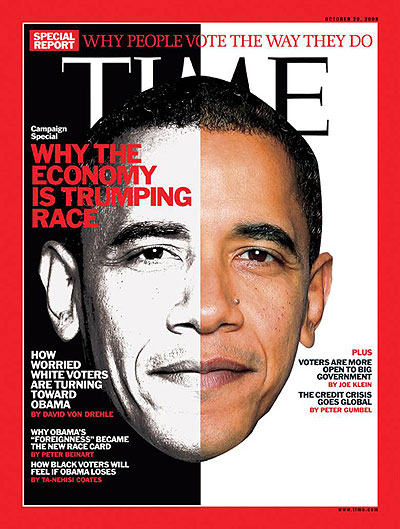
#3: Hit or Stick, the Race Card & Obama - What Obama's racial profile has meant for his presidency.
(Image thanks to bagnewsnotes.com)

From Street's book, Obama has been noticeably reluctant to explicitly align himself with the historical struggle for black equality or to confront the continuing problems of race and racism in America and Global Affairs” ( Street 80).

I felt this was a revelation because of how some voters did in fact vote for Obama because he's black, his middle name Hussein, or whatever rumor or fact they heard. It's important to consider Street's observation, because any hint of Obama manipulating his racial profile during his campaigning has not been followed up upon in his presidency, at least not yet. Race has been a rather underplayed topic in the media, and thus far no atrocious outbreaks of racial violence have erupted, as far as we know. Maybe that connects to Obama's ability to make the media love him.

#4: Obama's public "appeal" came from...where? - What Obama has done with his presidency.

"President Obama's decision to increase military spending this year and in the future will result in the greatest administrative military spending sine World War II. This decision is beind made in spite of continued evidnece of extreme waste, fraud, abuse, and corporate welfre in the military budget. At the same time, spending on "non-security" domestic programs such as education, nutrition, energy, and transportation will be frozen..." (Censored 2011 67).

(Image thanks to openentrance.com)

Project Censored provides us with an example of Obama's corporate, military interests. While Obama has made some small motions towards increasing healthcare, education, and other domestic interests, we're seeing a lot of flow between Obama and Corporate and Military's pockets. Did Obama ever say "I will freeze spending on domestic solutions so military ventures may be the major focus of our money" during his speeches both behind the lectern and behind the YouTube page? This revelation supports the 'Obama Deception' idea floating around the media.

#5: Presidential Modeling - The nature of today's politics.

(Image thanks to breitbart.tv)

Which of these mean would be most appealing on a screen? Probably Obama. Why? Age, difference (he stands out, that doesn't have to be a bad thing), he's well spoken, the list goes on. Street described our nation as having an “image-centered elections system and political culture” (Street 166). I think this has become prevalent in today's campaigning, and especially this past presidential election. Hilary Clinton appeared to be a swamp hag determined to devour your children and soul for leisure, while Obama was essentially depicted as Jesus Christ in a magazine or two.

How healthy is such a politicla culture? What if a candidate is too fat or thin, tall or short? If voters are put off and change their votes...what kind of voting results are we working with? What should votes be based on? I'd say political intentions and all that other political jazz.

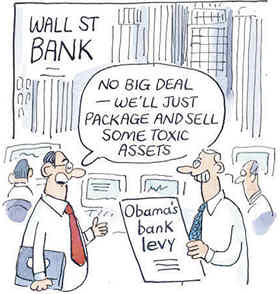
#6: Too long of a handshake? - Obama and the Banks
(Image thanks to static.seekingalpha.com)

Censored 2011 shows more of Obama: "President Obama used his sixth signing statement to negate provisions of US legislation that would have compelled the World Bank to strengthen labor and environmental standards" (Censored 2011 101). Presidents evidently have to balance the interests of the public and the corporations. I guess the idea behind democracy is that the public will be favored, as such probably is the majority's will. Obama seems to like to keep the corporations happy, the banks seemingly most of all.

Perhaps that has to do with the healthy amount of contributions Wall Street and the banks gave his campaign. How would we know whose hands shook whose? That we don't, and probably never will, know the truth of Obama's agenda is the overarching revelation. The guise of politics, huh?

#7: Obama's reality construction - Candidate Obama v. President Obama.
"Would an Obama presidency really ‘turn the page’ away from big-money influence and melt the icy stranglehold that concentrated wealth has long had on US politics and policy?" (Street 3).
(Image thanks to comicrelief.net)

This is a big picture revelation; this revelation made me think about Obama's contrasting persona: one for the public, one for the blank signature spaces on several policies and enactments. Obama is the public's hero, and remains upholding a solid loyal following, but his adverse actions have been exposed. Does it matter?

Obama has, through the lens of the media (not just the news), maintained the image of a heroic, valorous entity that will save us. Street's question, which I cited above, is an important question when considering what Obama has done thus far.

#8: Where importance lies - What is the right time to look good during a campaign?

From Media & Society, "Candidates who can demonstrate their electability by doing well in early polls are much more likely to attract the campaign contributions--before any votes are cast--that are essential to run an effective campaign" (Media & Society 239).

(Image thanks to politicolnews.com)

CHANGE! STAND FOR CHANGE! Look at the positivity flowing in that image. Obama is the people's person, the riled up masses simply a backdrop to his glorious visage. Here's what helped Obama so much, those early poll appeals, that early cash flow. Obama's campaigning effectiveness was based partially on his campaign squad's insight and knowledge, which was a direct product of the amount of money he had to give people. The more their paid, the more their motivated, at least in some cases.

The observation from our textbook rings true, and it's interesting. What if Obama hired that guy instead of this guy for his campaign predictions and productions? Would we have a different president? The importance of the parts of the whole is incredible in this game.

#9: A Change in Mind - Obama's appeal to a new audience.

(Image thanks to hollywoodtoday.net)

Postman said, in his book Amusing Ourselves to Death: Public Discourse in the Age of Show Business, "What kind of audience was this? Who were these people who could so cheerfully accommodate themselves to seven hours of oratory?" (Postman 44). Postman is talking about Lincoln and Douglass' speeches back in the day, speeches that lasted hours upon hours, speeches that the audience loved and absorbed.

How long would the audience last in Obama's picture? An hour? The change in our exposure to media, Postman's peek-a-boo world, gave Obama's campaign support, because his videos online were short and voluntary. We love snippets of information that gets diluted by distractions. Obama's YouTube videos provide that. You can absorb his image (and maybe his words) in a few minutes, and then click to related videos that are probably internet memes about Obama, which can be crude and funny. I've said it before: The Internet has changed the game. But, was it for the better?

#10: In the End - What Obama has meant for me, for us.

(Image thanks to blog.northstarmanifesto.com)

Postman gave some tenets of today's television. Here's part of one: "Every television program must be a complete package in itself. No previous knowledge is to be required...The learner must be allowed to enter at any point without prejudice" (Postman 147). Analyzing Barack Obama and the nature of politics (and its relationship with the media) has made me question what's important to a voter. Postman's tenet here, the cited part, is fulfilled in Obama's YouTube videos. Each video is independent, where a viewer can follow an entire story and message.

My revelation is that the development of this form of media exposure is detrimental to political accuracy. Debates aren't what they could be because of this tenet. Could you imagine a candidate recalling back to specific periods of history to prove a point? No one would know what he or she is talking about. With Obama I've seen promises broken and contradictions fulfilled. I've seen audiences riled at the thought of hope, and masses let down at the decay of that hope. Perhaps the nature of Obama's intentions weren't overly clear because of how they were conveyed to us.

Sunday, December 5, 2010

Media Meditation #6: Would you cook and sell meth to help your family?


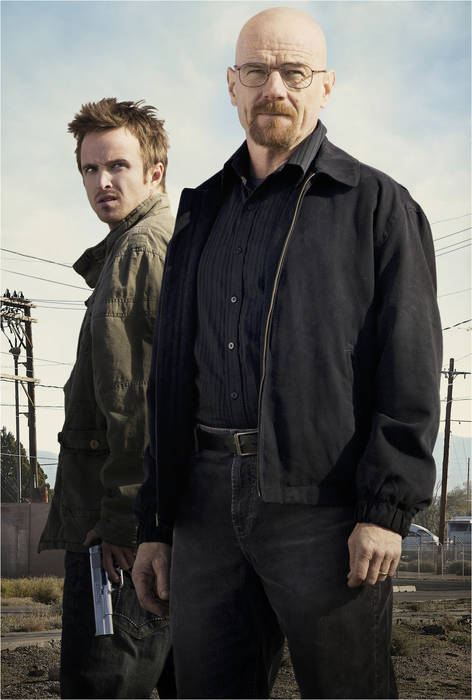
Bryan Cranston's character, Walter White, answered yes. His cooking and selling of meth is quickly the main point of plot development for the incredible show Breaking Bad. You might know him as Hal from Malcolm in the Middle, but Bryan Cranston's best characters is certainly Walter White.

Appearing above, in front of his partne
r Jesse Pinkman, who played by Aaron Paul, Walt tries to balance meth cooking, a wife, son, and soon-to-be-born daughter, and the complete separation of the aforementioned elements all while quickly (sort of a spoiler) getting diagnosed with lung cancer.

A lot of how this unfolds has been seen in the 3 seasons that have aired so far. Season 4 has been confirmed and I can't wait.

The production technique that has been most influential in shaping the strange, looming, and intoxicating aura that the show
boasts, is the seemingly random opening scenes of most of the episodes. A series of scenes consists of a pink stuffed animal floating in a pool, and getting picked out by a pool net. Curious. This happens before any of that is given context, so the viewer is so disoriented. Normally this might be a negative, but the show eventually makes it all make sense, and the rest of the show is so good it doesn't matter.

One of the most charming parts of the show is its ability to explore the discursive shift. It shows a world, drug dealing, that is depicting with only one side, the side of the media, to most Americans. A lot of people probably view cooking and selling meth as a low form of life, set aside for people with no other skills or aspirations. The show breaks that one sided, subjective view by showing the human side of the business. Walt is an impressive chemist, and teaches it as his local high school. He brings that to the drug trade and makes a mean product: the most popular, pure meth seen in Albuquerque (oh, yeah, it's set in New Mexico, which makes for some fantastically unique scenery and landscapes).

He goes into the drug trade, working with Jesse to sling crystals. He works with Jesse's friends. Here's one of them, Skinny Pete:

He talks and acts like a person your everyday working American might view as a hooligan, drug addict, or low life. But through his lines and actions, especially in dealing with emotional situations that everybody, even drug addicts, go through, he shows he is human, and is just like everyone else. He consoles Jesse, gets impacted by situations, and justifies his actions. They all do. They all try to, at least. That's one of the biggest issues in the show: Justification. Especially for Walt. This what I mean by their exploration of the discursive shift. Showing the other side, the complete side, of drug addicts, drug dealers, drug lords. This point is given life if you watch the show.

Watch the show.

Rhetorical questions seem to appear on their own through the situations in this show. "Is Walt going to..." "What if I was in the situation ... was in?" Take the title of this post for another example. Beautiful people is probably being used in this show. Walt's wife, Skyler, is bangin'. She looks like a mother, sure, but she's a hot mother. I feel that in the situation they are in, a less attractive female lead might have been just as appropriate, but the producers decided on hot, probably following the still very alive notion, full of truthiness, of: Sex(iness) sells.

The big word that comes up, especially early in the show, is maybe. Maybe, maybe, maybe. Maybe Walt will settle this with words, or maybe with that pistol. Maybe Skyler will be accepting, or maybe she won't be. Maybe Jesse will get clean, maybe he won't. Maybe they will be successful in cooking and selling, maybe not. There are many more maybes, but they would reveal too much information about the show, and I don't want to ruin this experience for anyone!

Big lie is a technique not so much that the show uses, but that the show's plot uses. Walt lies to Skyler and everyone he knows because he obviously doesn't want to go to jail and lose everything he loves. This puts him in a shitty spot because he's doing the illegal to support his family after he's gone. Bear that lung cancer he has in mind. Bribery works in the same way, because the meth dealing business and lung cancer bribes, as I see it, Walt into the meth cooking. He learns that you can make serious money by selling meth through his brother-in-law's seizure of drug funds through his work in the DEA. Enticed by the money, Walt decides to get into it.

Reality construction is on the other side of the scale with the discursive shift. Because while the show can expose the drug world in a fair light, showing the drug addicts in a human scope, there is concern at how justified the show makes drug dealing out to be. You are, in the end, pushing out product that innebriates users heavily, sometimes to dangerous levels (overdosing, otherwise not-occurring violence, etc.). Is Walt making enough money to support his family worth the massive scale production and distribution of an undeniably harmful substance? To watch the show with healthy media literacy, such questions needs to be kept in mind.

Media Meditation #5: Childish Gambino


This is the face of Donald Glover. (Image thanks to www.thelongdrivehome.com)


This is the face of Childish Gambino. (Image thanks to www.inyourspeakers.com)

Look...so similar.

Donald Glover, writer, actor, comedian, rapper, has been making music under the alias of Childish Gambino for awhile now. If you've read this blog before you might recognize his face from some videos in a previous post. He's one of the bro rapists in the Bro Rape video, and also was (is? Hopefully.) a front man for Derrick Comedy.

He's written for 30 Rock, acts, in a main role, on the show Community, makes great music (remixes under the other guise 'mcDJ'), and is a comedian. I have nothing but respect for him and I've chosen Childish Gambino for my meditating.

Here are a couple of great tracks:


AND


Both rather different, both rather great.

The reason I chose Childish Gambino, Donald Glover, is because he is an embodiment of convergence, and because music, his specifically for this post, is fantastic.

I've been a fan of this guy before his name got out there, back when he was making the first Derrick videos. It's awesome to see he's making it big (it seems like he is, at least), and he's continued to prove that he deserves stardom.

Donald Glover's production techniques are, as he emboldens through his lyrics, different. His Childish Gambino songs usually use music from his alter persona, mcDJ, as a backdrop for his rapping. The music isn't what you might think would be the back beat to rapping, but it works. He has released mix tapes using other artists' songs, some that certainly don't lend themselves to the rap/hip-hop genre. Those songs are solid as well.

A lot of his lyrics seem to either make fun of or embrace a multi-faced 'rapper' persona. At times he will pour out his soul, which I've seen online described as "Donald Glover coming out through Childish Gambino", and at others he will be using strength in his words to bolster and enliven his ability to rap and live.

His album covers and titles seem to utilize nostalgia and symbols in their appeal to an audiences. For me at least, this album cover brings back memories:


(Image thanks to childishgambino)
This is from his upcoming EP release, so I can't say much about the content, but the picture captures some of the ideas behind Childish Gambino's work. I remember fall for the first time, not surprisingly as a child, and all of the memories from those child hood years where leaves of autumn were a new change each season, an incredibly exciting arrival.

Another album of his, Culdesac, reminds me of my childhood more because I grew up near, basically on, a culdesac. It's a corner stone of suburban living.

His lyrics will also, while being strong, occasionally play the race card. One line in a song goes, "I'm young and I'm black and the world is my oyster...."

He has chosen to mention that he's black, mention his race. And why not? It's a fact that certainly has been influential in the rap/hip-hop genre in the past.

As I said before, Donald Glover is the human manifest of the aesthetic shift. Technology has converged into platforms of great performance and ability. Donald Glover has followed suit. Expressing himself in not just one, or two, or three, but four mediums(!), he has spread his message fast and hot, reaching minds and dropping his thoughts on, to quote from the interview found below, "the spices of life."

Glover also has some interesting relations with the technological shift. From ANALOG to DIGITAL seems to have been an easy, maybe gradual, process for him. Derrick Comedy videos were on YouTube to start, so they had the DIGITAL ways captured early on. They, Derrick Comedy, were also a performing sketch troupe in New York City. They had a dual platform of expression, at least, and that helped get their names above the rest of countless YouTube uploaders.

Donald Glover has this dual-platform idea, but now it's a quadruple-platform of expression. Clearly it's been working for him. As he continues to put out his work, I will strive to enjoy it. Hats off to him!

Sunday, October 31, 2010

Media Meditation: Getting Hungover

Yes, it is Halloween weekend, and the title of this post can apply in that regard, but I'm talking cinema.

Many comedy loving movie goers were greatly satiated by The Hangover. Recently watching this movie was no less fulfilling than expected. Its outrageous antics and phenomenal performances create a solid experience with the screen. It starts off with the main characters revealing the main point of the movie: they lost their friend Doug after a wild night in Vegas.

Starting out with a scene that seems like it should be later in the movie (and it still is), or as a circle story, shows that the production techniques were considered and this was the final choice. Why? Because it makes you wonder what the hell happened to them, rather than watch them going to Vegas with no idea about what's going to happen. It gives the scenes a nice lack of mystery because, while the scenes are frickin' hilarious on their own, they would not seem to have much of a direction.

To get a better idea of the movie, if you haven't seen it, check out one of the trailers:


Humor is another big player. Alan's wolf pack speech is priceless (the scene on the roof, prior to the roofies). Mike Tyson plays a role, providing his testimonial to the movie's cause. Tyson's tiger, when first introduced, triggered my reptilian brain (specifically the flight mechanic, its a tiger!). The soundtrack is almost hilarious because we have a school teacher, dentist, one man wolf pack, and husband to be rolling to Vegas to hip pop. We have Mike Tyson jamming out to Phil Collins' "In the Air Tonight". My limbic brain enjoyed much of the music.

Ownership and film, specifically comedies, have never seemed to have much to them. Whoever owns The Hangover, good for them. I don't detect any secret agendas, but rather a hilarious movie. Some movies portray themes that are suggestive of a stance on a controversial subject of present day, but here we have three guys in a sympathetic, but over the top, predicament that uses a popular venue as a stage.

Our shift from regulation to deregulation has allowed a lot of freedom in the portrayals seen in theaters. In this movie we see a baby being made to pretend masturbate, kids shooting stun guns by an irresponsible policeman's will, and a naked Asian man leaping out of the trunk of a car and onto a man' face. The lack of regulation, and thus potential snuffing of this apparently innovative form of comedy (outrageous situations), allows this and many other films a whole lot of flexibility and subjects to consider.

The entire movie is a Big Lie. We're told that Phil might be getting corpse raped in a ditch, or another horrid fate, and are led to believe that his fate is sealed, while (SPOILER) he is just sleeping on the roof. We're also told that they've found Doug when, as we're told later, they haven't. We're bribed to watching more because it seems as though there is a solution about to arise, but in fact it does not.

The whole movie also uses symbolism because Las Vegas is a symbol of these bad decisions that were made, resulting in the night the movie is about. There is also some profound scientific evidence from Phil: We all do dumb shit when we're fucked up. Employing repetition, the main characters are constantly running into over the top characters messing up their pursuit of Doug.

Riddled with persuasion and media technique, The Hangover is a great movie that is worth seeing if you want to laugh.


Media Meditation #3: Subtle Sexuality


If you've ever seen The Office, you'll be able to appreciate the subject of my meditation. As it's a video, I would have liked to post the video directly on the blog, but (I've never seen this) embedding for the video has been "disabled by request". I can provide the link: Watch Subtle Sexuality: The Music Video!

This particular media text is appealing to me for a few different reasons. It's a rockin' music video starring great characters from a hilarious show.

Firstly, it's a well composed song. My limbic brain is engulfed in the music and lyrics as they are coordinated to various physical act
ions by the beautiful duet of Kelly and Erin (beautiful people right there). Neocordically speaking, my aim is to interpret the clever lyrics. The production techniques being used encourage your attention. The fast cuts and aforementioned coordination between sound and sight keep the speed rapid and a viewer's attention tightly grasped.

Through analyzing the ownership of this video, some interesting revelations come about. This video is about a male prima donna. Ry
an Howard, from the Office (he's Mr. Understood, the guy in the white get up near the end) is Kelly's (the star) boyfriend in the show and in real life! The lyrics are definitely influenced by this and its funny to realize that this song, from a show, is about a relationship in real life that exists in the show as well.

Cleverness is seen through persuasion. Humor is obviously a technique being utilized, but some of the lines invoke certain thoughts that keep us watching. The line "Like Shakespeare said: To be or not to be, sometimes you're Romeo with me" is using a non traditional form of testimonial. Kelly and Erin use strawman to cut down Ryan (the male prima donna). For example:

You're cute but you think you're blazin' hot
You're short and you think you're not,
You look gay in your skinny tie!
I hope you get killed in a drive-by!

The most incredible part of the video is about two minutes in, when this guy first makes his appearance:


His inclusion in the video brings back nostalgic (nostalgia) memories of the Nard Dog's introduction and legendary translation from the Stamford branch of Dunder Mifflin to the beloved Scranton Branch. If you don't know the Nard Dog, you don't know The Office. If you don't know The Office, well, read up on that first link I provide.

The personal shift shows us that this video's creation has larger implications than simply another production. This is essentially a side project, not included in any episode of The Office. Producing a series of webisodes, The Office cast has begun to participate in the digital community. This one features the four cast members found in the video, but not The Office crew as a whole. Some other series of webisodes features other members from the office (one series is primarily Kevin and Darryl, for you avid Office viewers). The same information can show us more through the technological shift. We have a song and a video being meshed into the digital world by being purely an internet based video. This allows companies, like NBC, and shows, like The Office, to reach out to its audience easily and provide further details about the show without cramming it into the time frame of slotted broadcast television.

The Nard Dog's sexy smile, Mr. Understood spitting fire and his hilarious gestures (the cut to him in the bathrobe as he says "SO SLOW!" was too funny!), and Kelly and Erin's facial expressions and motions (particularly Kelly's face; she looks like she's having a great time) made a fantastic video that gave some of the references in the actual show some substance.

Sunday, October 17, 2010

Censored 2011: Amazon Massacre


(Image thanks to guardian.co.uk)

Can a story be completely censored? Can all parties included be certainly silenced? The censored stories are the ones that must contain parties most wanting to speak out. Censored 2011's 8th story is titled, "Massacre in Peruvian Amazon over US Free Trade Agreement".

Let's start with an idea of what this story is about. Here's what should be known:
  • The US–Peru Free Trade Agreement was signed on December 8, 2005, in Washington, DC, by then presidents George W. Bush and Alán García, whose government
    al body is behind the censored conflict. In June 2006, it was ratified by Peru, and in December 2007 by the US Congress. On December 19, 2007, Peru’s Congress gave full faculties to the government to legislate, for six months by decree, issues related to the FTA. Mandated by these powers, the executive drafted ninety-nine legislative decrees. On February 1, 2009, the agreement went into effect.
  • The legislative decrees are numerous and rather unfair to the indigenous people living in the Peruvian Amazon. For example, "LD 1083 (Promotion of Efficient Use and Conservation of Hydraulic Resources) favors the privatization of water to large consumers such as mining companies."
(Image thanks to Global Patriot)
  • "It is LD 1090 (Forestry and Woodland Fauna Law), however, that is at the crux of the debate. This decree leaves 45 million hectares out of the forestry framework, that is, 64 percent of the forests of Peru, including their biodiversity in flora and fauna, making it possible to sell this vast commonwealth to transnational corporations."
  • On April 9, over one thousand indigenous communities of the jungle regions agreed to start demonstrating. The demonstrations were peaceful attempts to stop oil pipe lines and other industrial additions to the forest. These additions were those created by the decrees set in place by the Free Trade Agreement.
  • On World Environment Day, June 5, 2009, protesting Peruvian Amazon Indians were massacred by the government of Alán García. Three MI-17 helicopters arrived at a section of the Peruvian highway that connects the jungle to the northern coast. That section had, for ten days, five thousand Awajún and Wampi indigenous peoples. The helicopters unleashed tear gas and allegedly machine guns as a ground force of Alán García's deployment began to fire off rifle rounds into the crowd. "An estimated five hundred police bore down on the protesters, some of whom were still sleeping, and opened fire."
(Image thanks to Intercontinental Cry)
  • "The government claimed days after the clash that eleven indigenous were dead as well as twenty-three police agents. The indigenous organizations reported fifty dead among their ranks and up to four hundred disappeared. According to witnesses, the military burned bodies and threw them into the river to hide the massacre, and also took prisoners from among the wounded in hospitals."
  • Written by Hugo Blanco, a Peruvian activist, about the results of this ongoing struggle, “After 500 years of silencing, the Amazon peoples receive the support of the peoples of Peru and the world. The greatest achievement of this campaign has been to make these nationalities visible, weaving links between diverse sectors of the country, as divided as those who dominate. By defending the Amazon we are defending the life of all of humanity; and by not ceding to the deceit of the government, they are rewriting history, recuperating for all the sense of the word dignity.”
A mix of LexisNexis and internet browsing turned up several results regarding this story. Here are some varied sources of coverage:


On top of the news stories, which can be found on several other websites, there were many pictures of the event--collectively shown at Amazon Watch.

On top of that, there are many videos covering what happened. Here's one,


Here's another video. This one puts you right in the action:


Another easily found video covering what happened:


However, this coverage from Ground Report included sources that I wouldn't expect (definitely to be appreciated in this class).

And one last example of the coverage of the Peruvian Amazon Indian's struggles is an archive, lengthy indeed, of what you can do, what and where to research, and news coverage of specific occurrences in the Peruvian Amazon. It was made by Ray Beckerman.

I can't say that this story is censored. It is everywhere. I have to say that it's inclusion in Censored 2011, and its alleged poor coverage and awareness, is probably a product of distance, no direct interest, and the story's susceptibility to getting washed over in feature stories and television programming.

A lot of major companies (BBC, NYT, US Dept. of State, etc.) covered the event and continued to talk about what developed (suspension of the decrees by the Peruvian government; table negotiations to start between the government and the indigenous peoples; wider spread awareness, indicated by the related protests in NYC), so anybody who subscribes to these sources of news would have read the story, but the question is: Do they retain that knowledge and potentially act on it or just embrace the shock and sympathy before swiftly moving on to the next story? In this case I'd have to say the latter.

As a final note, from Ray Beckerman's archive (mentioned above) comes this slideshow illustrating the conflict and threatened beauty in the Peruvian Amazon. As the title says, be careful (DISCLAIMER) there are some rather disturbing pictures.


My Media Empowerment: A Mid-Class Reflection

Getting to the half way mark (already!) it's only proper to ponder about the possible improvement a person can attain through media education. I myself have been empowered.

(Image thanks to cdn.mashable.com)

1. After studying media for eight weeks in Contemporary Media Issues, what have I learned?

Being familiar with the power tools from past classes, Mass Media & Society as well as Electronic Media Writing, the new reading materials were definitely the most effective at enlightenment. I've reinforced my ability to critically analyze media texts and understand where our technology comes from (the radio as a product of social traditions, for example).

2. What is the most important thing I have learned about myself as a critical reader, a writer, and a thinker in class so far?

Tapping Nicholas Carr, the way I've adapted to absorbing information has changed my ability to soak up a lot of dense material without focusing and possibly straining, but with the power tools' guidance it has become easier to pin point and contemplate deeper meanings.

3. What's one thing I would do differently if I were to repeat this first semester?

I would do my media meditations in a more timely fashion (still time to change that, eh?) and apply the power tools that aren't as commonly used. It's a lot easier to pick out the Humor persuasion being used, but sometimes recognizing, say, Cardstacking, can be more difficult. The greatest value and knowledgeable gain must come from utilization of every power tool as much as possible. Working towards that is what I would and am changing.

4. What's one thing I would like Dr. W to do differently if the first semester were to repeat itself?

There wasn't a lot of blogging discussion in class. That's a big change from the last two classes (MM&S, EMW). I would've liked more attention to our blogging assignments, but that seems to be on the way this class. Perhaps its the method, which seems to be: Read a text and blog about it in sections. Then, talk about it in a week, a few weeks, however long. I definitely like the idea of reading these texts independently and blogging about them to show that we've read them and are thinking about what was read, but the absence of any immediate discussion in class keeps that independence at a high. That's fine with me, but I would prefer discussion as I'm reading the texts.

5. Here are my thoughts on the usefulness of our various in class materials.

Power Tools: They remain an invaluable set of tools that I use consistently in class and even outside of class in my own considerations and analyses. They've given me easier routes to contemplative thought and raise questions that can spark up a conversation, be it an inner debate or a friendly discussion.

Quizzes: The key to reinforcing the usage of the power tools, the quizzes give opportunities to apply our media educated minds to a variety of texts and confirm that we are thinking about media in the same way as our peers. Deeping meanings can be actively considering through applying the power tools to our various media texts during the quizzes.

Here's one of the most eccentric videos we applied the tools to:


Course Blog: An awesome way to keep up with the expectations and is also a great visual additions, rather than staring at a week-by-week syllabus schedule.

Personal Blog: Always a joy. The customization is so much fun and so often absent from the every day homework assignment. It is neat to have a cache of all the work done each semester. Looking at all of it at the end of the semester is enriching and exciting. I re-read my EMW blog and it was an enjoyable read. It allowed me to really read my own writing in a similar way I would read another's writing. The assignments from the start were inherently foggy, so it wasn't as though I was dreadfully familiar with what was written.

Films: I never know what to expect, but they are always one, some, or all of these: Entertaining, relevant, and enlightening. Real Bad Arabs, for example, was relevant and enlighteneing. Entertainment didn't seem to be the goal of that documentary, so there's no questioning its absence of entertaining bits.

Books: FEED was a great pick. It was an enjoyable novel on its own, but it also related so heavily to the themes being taught in class. The jargon was great and the ideas conveyed were powerful and relevant to what was going on. It had the ideas of a text book but the enjoyability of a novel.

Postman: My favorite. It was very enlightening and really got me thinking about media as a whole and how information is portrayed to me, as an American. It provided ample opportunities for disagreement but also provided ample segments of insightful and satisfying material that changed how critical of the news, and television as a whole, I am.

Media & Society: 'lot o' good information in that book. Almost the textbook version of FEED, it touched on so much about media. The most informative bits to me were about the considerations of the different aspects of life technology effects. Learning about, and coming up with key concepts for, the social forces that have driven technological usage was one of the most engaging assignments of the year.

The Google Dumb/Smart Articles: Cascio and Carr raised great ideas about Google and the nature of the interent. While I don't agree with the severity of the situation (I can read three paragraphs on a blog no problem, I don't know how much that other guy in Carr's article was on the internet, but come on) I felt that the ideas were greatly powerful and mightily thought provoking. When I'm on the internet now I try to notice how much I retain and how much I don't. That's made me retain more and more.

So far I'm more than satisfied with the class and am impressed by the lack of over lap, even though I've taken two classes that seem very similar. Bravo, Dr. W!