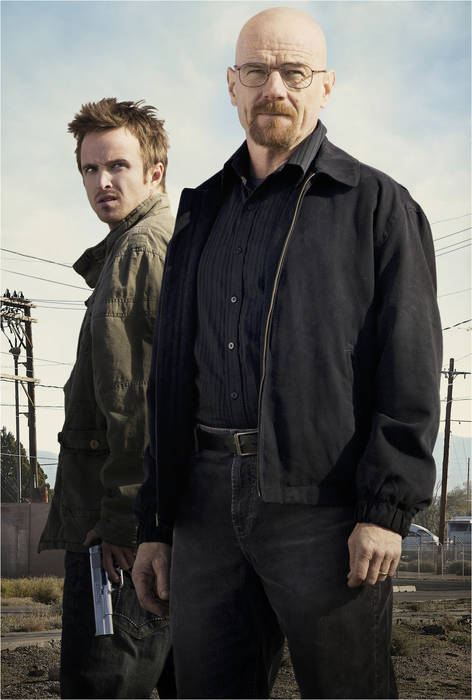
Appearing above, in front of his partne
r Jesse Pinkman, who played by Aaron Paul, Walt tries to balance meth cooking, a wife, son, and soon-to-be-born daughter, and the complete separation of the aforementioned elements all while quickly (sort of a spoiler) getting diagnosed with lung cancer.
A lot of how this unfolds has been seen in the 3 seasons that have aired so far. Season 4 has been confirmed and I can't wait.
The production technique that has been most influential in shaping the strange, looming, and intoxicating aura that the show
boasts, is the seemingly random opening scenes of most of the episodes. A series of scenes consists of a pink stuffed animal floating in a pool, and getting picked out by a pool net. Curious. This happens before any of that is given context, so the viewer is so disoriented. Normally this might be a negative, but the show eventually makes it all make sense, and the rest of the show is so good it doesn't matter.
One of the most charming parts of the show is its ability to explore the discursive shift. It shows a world, drug dealing, that is depicting with only one side, the side of the media, to most Americans. A lot of people probably view cooking and selling meth as a low form of life, set aside for people with no other skills or aspirations. The show breaks that one sided, subjective view by showing the human side of the business. Walt is an impressive chemist, and teaches it as his local high school. He brings that to the drug trade and makes a mean product: the most popular, pure meth seen in Albuquerque (oh, yeah, it's set in New Mexico, which makes for some fantastically unique scenery and landscapes).
He goes into the drug trade, working with Jesse to sling crystals. He works with Jesse's friends. Here's one of them, Skinny Pete:

He talks and acts like a person your everyday working American might view as a hooligan, drug addict, or low life. But through his lines and actions, especially in dealing with emotional situations that everybody, even drug addicts, go through, he shows he is human, and is just like everyone else. He consoles Jesse, gets impacted by situations, and justifies his actions. They all do. They all try to, at least. That's one of the biggest issues in the show: Justification. Especially for Walt. This what I mean by their exploration of the discursive shift. Showing the other side, the complete side, of drug addicts, drug dealers, drug lords. This point is given life if you watch the show.
Watch the show.
Rhetorical questions seem to appear on their own through the situations in this show. "Is Walt going to..." "What if I was in the situation ... was in?" Take the title of this post for another example. Beautiful people is probably being used in this show. Walt's wife, Skyler, is bangin'. She looks like a mother, sure, but she's a hot mother. I feel that in the situation they are in, a less attractive female lead might have been just as appropriate, but the producers decided on hot, probably following the still very alive notion, full of truthiness, of: Sex(iness) sells.
The big word that comes up, especially early in the show, is maybe. Maybe, maybe, maybe. Maybe Walt will settle this with words, or maybe with that pistol. Maybe Skyler will be accepting, or maybe she won't be. Maybe Jesse will get clean, maybe he won't. Maybe they will be successful in cooking and selling, maybe not. There are many more maybes, but they would reveal too much information about the show, and I don't want to ruin this experience for anyone!
Big lie is a technique not so much that the show uses, but that the show's plot uses. Walt lies to Skyler and everyone he knows because he obviously doesn't want to go to jail and lose everything he loves. This puts him in a shitty spot because he's doing the illegal to support his family after he's gone. Bear that lung cancer he has in mind. Bribery works in the same way, because the meth dealing business and lung cancer bribes, as I see it, Walt into the meth cooking. He learns that you can make serious money by selling meth through his brother-in-law's seizure of drug funds through his work in the DEA. Enticed by the money, Walt decides to get into it.
Reality construction is on the other side of the scale with the discursive shift. Because while the show can expose the drug world in a fair light, showing the drug addicts in a human scope, there is concern at how justified the show makes drug dealing out to be. You are, in the end, pushing out product that innebriates users heavily, sometimes to dangerous levels (overdosing, otherwise not-occurring violence, etc.). Is Walt making enough money to support his family worth the massive scale production and distribution of an undeniably harmful substance? To watch the show with healthy media literacy, such questions needs to be kept in mind.

No comments:
Post a Comment