#1: Changing Campaigning - How Obama's Campaigning Changed the Game

Barack Obama may have been only one of a handful of presidential candidates with the opportunity to use the world of Web 2.0 to his or her campaigning advantage, but he saw and leaped on the opportunity, harnessing it to great effect. Even today he uses his YouTube channel to post videos to his online following. The videos can be fairly straightfoward, but a form of free advertising and expression nonetheless. Here's one of the most recent videos, from November 1st of this year:
Get out there and vote, from Obama. Reminiscent of FDR's fireside chats, these videos allow any number of people to tune in very easily, puts a face to the voice, and allows for Obama's campaign team to track the hits and general popularity of the internet techniques Obama used.
From Hoynes and Crouteau's Media & Society, "Candidates have complete control over their media images when they produce their campaign commercials. Television advertising is a central part of most electoral campaigns, and some evidence suggests that voters receive more information about candidates from campaign commercials than from news coverage." (Crouteau & Hoyes 237)
This observation is a tad out of date because, as Obama has proven, the Internet can be just as, if not more, effective than television in its appeal to an audience. From The New York Times came an article touching on this very subject. From Clare Cain Miller comes the article "How Obama's Internet Campaign Changed Politics".
The article smooths a lot of the furled areas of this revelation. "Mr. Trippi argued that those videos were more effective than television ads because viewers chose to watch them or received them from a friend instead of having their television shows interrupted." (Miller) On top of this, the article shows that the YouTube videos were watched for a rough total of 14.5 million hours, which would cost $47 million dollars to broadcast on television. There we already see Obama's clever utilization of modern technology.

'How many hits does my new vid have?!'
(Image thanks to i.telegraph.co.uk)
Because this is a new form of campaigning, we aren't as comfortable with what a candidate might look like through a screen, safe from criticism. Now that we're seeing what Obama has actually been doing for the past two years, a lot of people feel deceived and probably neglected. "Deception" has been a big word surrounding Obama since his presidency, and his Internet marketing, his intoxicating promise of 'Hope' and 'Change', were definitely contributing in making the product a reality.
The probable intensity of the influence of the Internet on Obama's campaigning is clearly said by Arianna Huffington, editor-in-chief of the Huffington Post. From the same article, "'Were it not for the Internet, Barack Obama would not be president. Were it not for the Internet, Barack Obama would not have been the nominee.'"
#2: Setting the Stage - Obama's Media Dominant Campaign Raises the Bar.

(Image thanks to mindtoss.com)
As it has been said in our class text, Media & Society,
...the cultural practices of the people who adopt a particular technology shape the development and uses of that technology"(Media & Society 312).Another revelation about Obama would be how his use of technology is reflected through this observation from one of our class texts. As I talked about in my first revelation, Obama's use of YouTube got him 14.5 million hours of free advertising. That such a tactic seemed effective in winning the presidency makes Crouteau and Hoynes' observation quite potent.
The curious implications raise questions about the future. What will future presidents do with this past occurrence? Will the next candidates battle for dominance on the Internet, following the seemingly successful trend Obama has started? The social attraction his online presence gathered will be hard to ignore for future candidates.
#3: Hit or Stick, the Race Card & Obama - What Obama's racial profile has meant for his presidency.
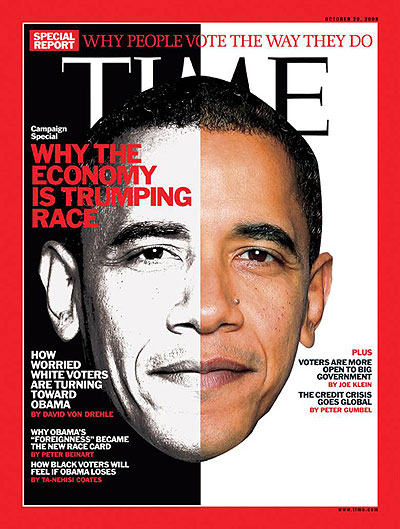
(Image thanks to bagnewsnotes.com)
From Street's book, “Obama has been noticeably reluctant to explicitly align himself with the historical struggle for black equality or to confront the continuing problems of race and racism in America and Global Affairs” ( Street 80).
I felt this was a revelation because of how some voters did in fact vote for Obama because he's black, his middle name Hussein, or whatever rumor or fact they heard. It's important to consider Street's observation, because any hint of Obama manipulating his racial profile during his campaigning has not been followed up upon in his presidency, at least not yet. Race has been a rather underplayed topic in the media, and thus far no atrocious outbreaks of racial violence have erupted, as far as we know. Maybe that connects to Obama's ability to make the media love him.
#4: Obama's public "appeal" came from...where? - What Obama has done with his presidency.
"President Obama's decision to increase military spending this year and in the future will result in the greatest administrative military spending sine World War II. This decision is beind made in spite of continued evidnece of extreme waste, fraud, abuse, and corporate welfre in the military budget. At the same time, spending on "non-security" domestic programs such as education, nutrition, energy, and transportation will be frozen..." (Censored 2011 67).

(Image thanks to openentrance.com)
Project Censored provides us with an example of Obama's corporate, military interests. While Obama has made some small motions towards increasing healthcare, education, and other domestic interests, we're seeing a lot of flow between Obama and Corporate and Military's pockets. Did Obama ever say "I will freeze spending on domestic solutions so military ventures may be the major focus of our money" during his speeches both behind the lectern and behind the YouTube page? This revelation supports the 'Obama Deception' idea floating around the media.
#5: Presidential Modeling - The nature of today's politics.

(Image thanks to breitbart.tv)
Which of these mean would be most appealing on a screen? Probably Obama. Why? Age, difference (he stands out, that doesn't have to be a bad thing), he's well spoken, the list goes on. Street described our nation as having an “image-centered elections system and political culture” (Street 166). I think this has become prevalent in today's campaigning, and especially this past presidential election. Hilary Clinton appeared to be a swamp hag determined to devour your children and soul for leisure, while Obama was essentially depicted as Jesus Christ in a magazine or two.
How healthy is such a politicla culture? What if a candidate is too fat or thin, tall or short? If voters are put off and change their votes...what kind of voting results are we working with? What should votes be based on? I'd say political intentions and all that other political jazz.
#6: Too long of a handshake? - Obama and the Banks
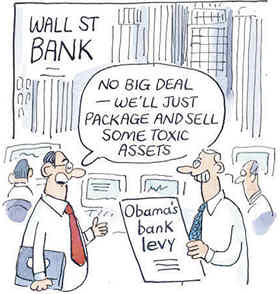
(Image thanks to static.seekingalpha.com)
Censored 2011 shows more of Obama: "President Obama used his sixth signing statement to negate provisions of US legislation that would have compelled the World Bank to strengthen labor and environmental standards" (Censored 2011 101). Presidents evidently have to balance the interests of the public and the corporations. I guess the idea behind democracy is that the public will be favored, as such probably is the majority's will. Obama seems to like to keep the corporations happy, the banks seemingly most of all.
Perhaps that has to do with the healthy amount of contributions Wall Street and the banks gave his campaign. How would we know whose hands shook whose? That we don't, and probably never will, know the truth of Obama's agenda is the overarching revelation. The guise of politics, huh?
#7: Obama's reality construction - Candidate Obama v. President Obama.
"Would an Obama presidency really ‘turn the page’ away from big-money influence and melt the icy stranglehold that concentrated wealth has long had on US politics and policy?" (Street 3).

(Image thanks to comicrelief.net)
This is a big picture revelation; this revelation made me think about Obama's contrasting persona: one for the public, one for the blank signature spaces on several policies and enactments. Obama is the public's hero, and remains upholding a solid loyal following, but his adverse actions have been exposed. Does it matter?
Obama has, through the lens of the media (not just the news), maintained the image of a heroic, valorous entity that will save us. Street's question, which I cited above, is an important question when considering what Obama has done thus far.
#8: Where importance lies - What is the right time to look good during a campaign?
From Media & Society, "Candidates who can demonstrate their electability by doing well in early polls are much more likely to attract the campaign contributions--before any votes are cast--that are essential to run an effective campaign" (Media & Society 239).

(Image thanks to politicolnews.com)
CHANGE! STAND FOR CHANGE! Look at the positivity flowing in that image. Obama is the people's person, the riled up masses simply a backdrop to his glorious visage. Here's what helped Obama so much, those early poll appeals, that early cash flow. Obama's campaigning effectiveness was based partially on his campaign squad's insight and knowledge, which was a direct product of the amount of money he had to give people. The more their paid, the more their motivated, at least in some cases.
The observation from our textbook rings true, and it's interesting. What if Obama hired that guy instead of this guy for his campaign predictions and productions? Would we have a different president? The importance of the parts of the whole is incredible in this game.
#9: A Change in Mind - Obama's appeal to a new audience.

(Image thanks to hollywoodtoday.net)
Postman said, in his book Amusing Ourselves to Death: Public Discourse in the Age of Show Business, "What kind of audience was this? Who were these people who could so cheerfully accommodate themselves to seven hours of oratory?" (Postman 44). Postman is talking about Lincoln and Douglass' speeches back in the day, speeches that lasted hours upon hours, speeches that the audience loved and absorbed.
How long would the audience last in Obama's picture? An hour? The change in our exposure to media, Postman's peek-a-boo world, gave Obama's campaign support, because his videos online were short and voluntary. We love snippets of information that gets diluted by distractions. Obama's YouTube videos provide that. You can absorb his image (and maybe his words) in a few minutes, and then click to related videos that are probably internet memes about Obama, which can be crude and funny. I've said it before: The Internet has changed the game. But, was it for the better?
#10: In the End - What Obama has meant for me, for us.

(Image thanks to blog.northstarmanifesto.com)
Postman gave some tenets of today's television. Here's part of one: "Every television program must be a complete package in itself. No previous knowledge is to be required...The learner must be allowed to enter at any point without prejudice" (Postman 147). Analyzing Barack Obama and the nature of politics (and its relationship with the media) has made me question what's important to a voter. Postman's tenet here, the cited part, is fulfilled in Obama's YouTube videos. Each video is independent, where a viewer can follow an entire story and message.
My revelation is that the development of this form of media exposure is detrimental to political accuracy. Debates aren't what they could be because of this tenet. Could you imagine a candidate recalling back to specific periods of history to prove a point? No one would know what he or she is talking about. With Obama I've seen promises broken and contradictions fulfilled. I've seen audiences riled at the thought of hope, and masses let down at the decay of that hope. Perhaps the nature of Obama's intentions weren't overly clear because of how they were conveyed to us.