
(Image thanks to guardian.co.uk)
Can a story be completely censored? Can all parties included be certainly silenced? The censored stories are the ones that must contain parties most wanting to speak out. Censored 2011's 8th story is titled, "Massacre in Peruvian Amazon over US Free Trade Agreement".

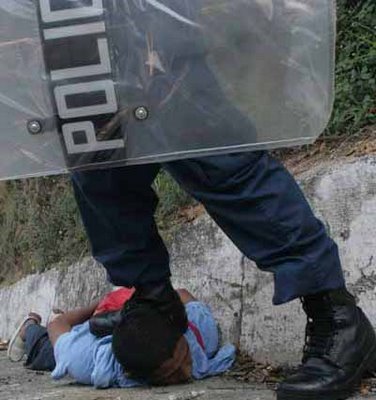
Let's start with an idea of what this story is about. Here's what should be known:
- The US–Peru Free Trade Agreement was signed on December 8, 2005, in Washington, DC, by then presidents George W. Bush and Alán García, whose governmental body is behind the censored conflict. In June 2006, it was ratified by Peru, and in December 2007 by the US Congress. On December 19, 2007, Peru’s Congress gave full faculties to the government to legislate, for six months by decree, issues related to the FTA. Mandated by these powers, the executive drafted ninety-nine legislative decrees. On February 1, 2009, the agreement went into effect.
- The legislative decrees are numerous and rather unfair to the indigenous people living in the Peruvian Amazon. For example, "LD 1083 (Promotion of Efficient Use and Conservation of Hydraulic Resources) favors the privatization of water to large consumers such as mining companies."
(Image thanks to Global Patriot)
- "It is LD 1090 (Forestry and Woodland Fauna Law), however, that is at the crux of the debate. This decree leaves 45 million hectares out of the forestry framework, that is, 64 percent of the forests of Peru, including their biodiversity in flora and fauna, making it possible to sell this vast commonwealth to transnational corporations."
- On April 9, over one thousand indigenous communities of the jungle regions agreed to start demonstrating. The demonstrations were peaceful attempts to stop oil pipe lines and other industrial additions to the forest. These additions were those created by the decrees set in place by the Free Trade Agreement.
- On World Environment Day, June 5, 2009, protesting Peruvian Amazon Indians were massacred by the government of Alán García. Three MI-17 helicopters arrived at a section of the Peruvian highway that connects the jungle to the northern coast. That section had, for ten days, five thousand Awajún and Wampi indigenous peoples. The helicopters unleashed tear gas and allegedly machine guns as a ground force of Alán García's deployment began to fire off rifle rounds into the crowd. "An estimated five hundred police bore down on the protesters, some of whom were still sleeping, and opened fire."
(Image thanks to Intercontinental Cry)
- "The government claimed days after the clash that eleven indigenous were dead as well as twenty-three police agents. The indigenous organizations reported fifty dead among their ranks and up to four hundred disappeared. According to witnesses, the military burned bodies and threw them into the river to hide the massacre, and also took prisoners from among the wounded in hospitals."
- Written by Hugo Blanco, a Peruvian activist, about the results of this ongoing struggle, “After 500 years of silencing, the Amazon peoples receive the support of the peoples of Peru and the world. The greatest achievement of this campaign has been to make these nationalities visible, weaving links between diverse sectors of the country, as divided as those who dominate. By defending the Amazon we are defending the life of all of humanity; and by not ceding to the deceit of the government, they are rewriting history, recuperating for all the sense of the word dignity.”
A mix of LexisNexis and internet browsing turned up several results regarding this story. Here are some varied sources of coverage:
On top of the news stories, which can be found on several other websites, there were many pictures of the event--collectively shown at Amazon Watch.
On top of that, there are many videos covering what happened. Here's one,
Here's another video. This one puts you right in the action:
Another easily found video covering what happened:
However, this coverage from Ground Report included sources that I wouldn't expect (definitely to be appreciated in this class).
And one last example of the coverage of the Peruvian Amazon Indian's struggles is an archive, lengthy indeed, of what you can do, what and where to research, and news coverage of specific occurrences in the Peruvian Amazon. It was made by Ray Beckerman.
I can't say that this story is censored. It is everywhere. I have to say that it's inclusion in Censored 2011, and its alleged poor coverage and awareness, is probably a product of distance, no direct interest, and the story's susceptibility to getting washed over in feature stories and television programming.
A lot of major companies (BBC, NYT, US Dept. of State, etc.) covered the event and continued to talk about what developed (suspension of the decrees by the Peruvian government; table negotiations to start between the government and the indigenous peoples; wider spread awareness, indicated by the related protests in NYC), so anybody who subscribes to these sources of news would have read the story, but the question is: Do they retain that knowledge and potentially act on it or just embrace the shock and sympathy before swiftly moving on to the next story? In this case I'd have to say the latter.
As a final note, from Ray Beckerman's archive (mentioned above) comes this slideshow illustrating the conflict and threatened beauty in the Peruvian Amazon. As the title says, be careful (DISCLAIMER) there are some rather disturbing pictures.


Intense (and EXCELLENT) oral/blog on this Amazon CENSORED story, Ted.
ReplyDeleteYou use the blog to summarize and research with fine use of our Web 2.0 power tools.
And thanks for all the links to related stories...
Bravo,
Dr. W